
Key points
- Feeling lonely often means there is a mismatch between the social relationships you have and the social relationships you would like to have.
- This can be in the number of friends and other social contacts you have, or in the quality of those friendships (e.g. having people you can confide in and trust, people you feel connected to who share something in common with you, feeling satisfied with your relationships).
- Loneliness can also relate to a sense of not belonging or not knowing your place in the world.
- Loneliness can be seen as a signal that you need more connection, a bit like hunger signaling it’s time to eat.
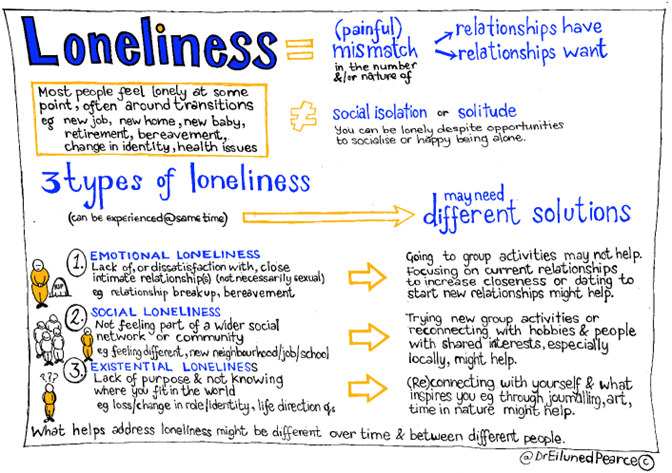
- The image below describes three different types of loneliness, which may need different solutions. By being clearer about what kind(s) of loneliness you’re experiencing you can see what the most helpful response might be.
- Different things might help address your loneliness at different times, and what helps you might not necessarily help someone else and vice versa, so try and see the things you try out as experiments.
- Don’t be disheartened if it takes a while to find the right thing for you at the moment.
What is loneliness?
Loneliness can mean different things to different people, but is often defined as a mismatch between the relationships we have and the relationships we want to have. Most people feel lonely at some point in their lives – it’s a natural part of being human, and can particularly happen around transitions like going to university, breaking up with partners, moving home or starting a new job.
How can we address loneliness?
There are different kinds of loneliness, and these may need different responses. We can experience more than one type of loneliness at a time, so multiple responses may be needed and these may change over time.
Emotional loneliness happens when we lack or are dissatisfied with close intimate relationships, for example when a good friend moves away or a romantic relationship breaks up. It might help to focus on deepening current relationships, or dating to start new relationships. If you’re experiencing this kind of loneliness, joining a social group might not be what you need, unless if provides opportunities to create close connections.
Social loneliness is about not feeling part of a wider social network (aka relational loneliness) or community (aka collective loneliness). This could be the result of experiences like feeling ‘different’ or moving to a new neighbourhood. It might help to try out new group activities or reconnecting with hobbies with likeminded people, especially locally to where you live.
Existential loneliness is about lacking purpose and not knowing where you fit into the world, for example due to a loss or change in identity or having questions about the direction you want your life to go in. Addressing this kind of loneliness might involve (re)connecting with yourself and what inspires you. This could be through art, spending time in nature, or mindfulness. Find out what you love to do and share this with others.
Suggested reflection questions
- Do you relate to any of the three types of loneliness?
- How do you know when you’re feeling lonely?
- What do you tend to do when you feel like this?
- What might you do to address the experience of loneliness (i) in the moment (ii) in the longer term?
Resources that might help
Co-produced Conversations around loneliness and mental health: What helps and what to do if it doesn’t:
Addressing loneliness isn’t always just about connection with other people, it can also be about connecting with yourself and/or with nature. [Google for a list of activities to try in Oxfordshire]