
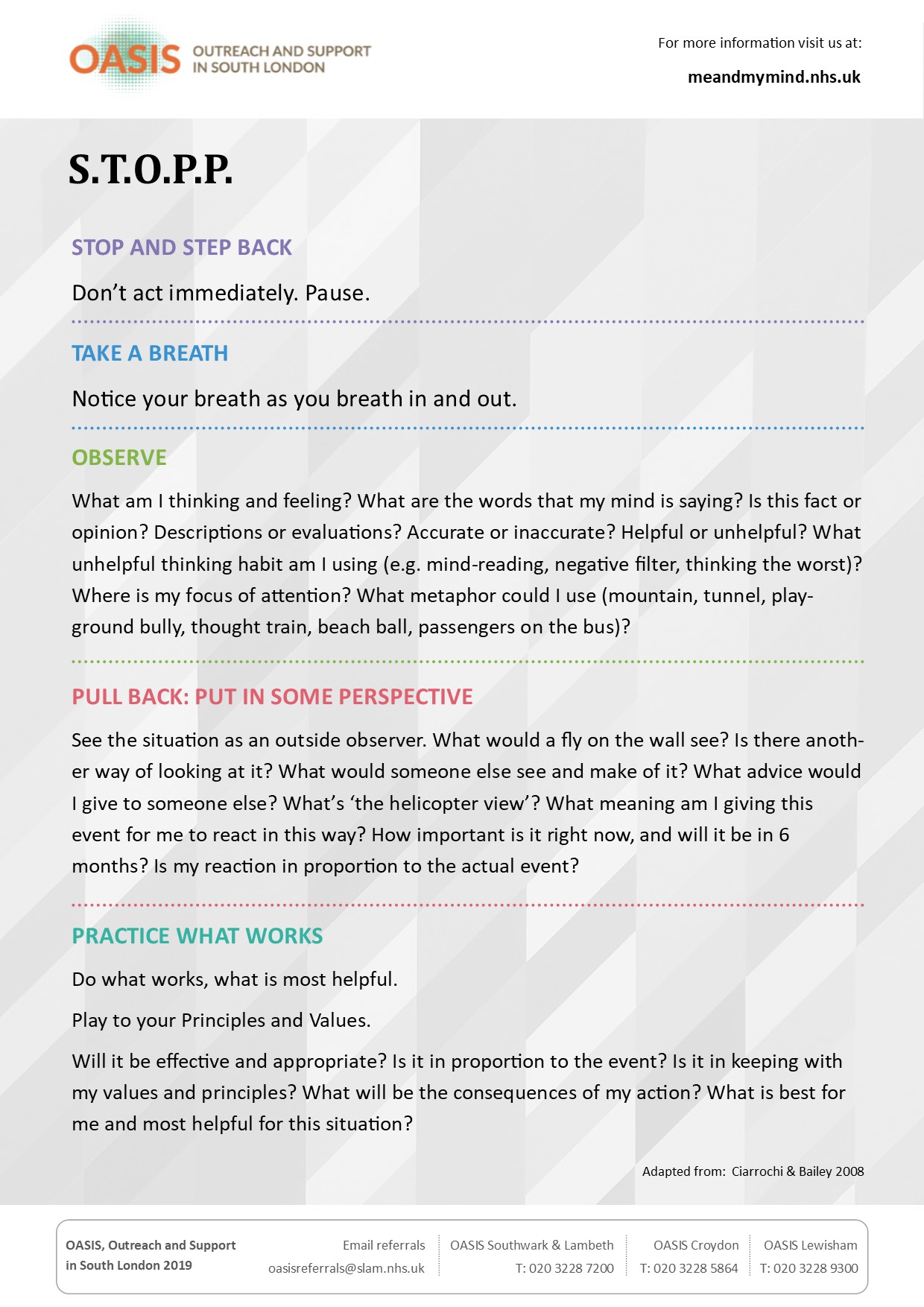
Sometimes we can have intense emotional reactions to situations that feel overwhelming (e.g. feeling angry, sad, overwhelmed). We need to learn how to understand our needs and express them in a healthy way. A first step towards this might be to S.T.O.P.P.
| Stop and step back | Don’t act immediately – pause. |
| Take a breath | Notice your breath as you breathe in and out. Can you take a few slow breaths? If appropriate, you might want to look at the Headspace series Headspace – YouTube, or try a 3 minute breathing space. |
| Observe | What’s happening? What am I thinking and feeling? What are the words that my mind is saying? Is this fact or opinion? Descriptions or evaluations? Accurate or inaccurate? Helpful or unhelpful? What physical sensations do I notice in my body? Where is my focus of attention? |
| Pull back: Put in some perspective | See the situation as an outside observer. What would a fly on the wall see? Is there another way of looking at it? What would someone else see and make of it? What advice would I give to someone else? What’s ‘the helicopter view’? What meaning am I giving this event for me to react in this way? How important is it right now, and will it be in 6 months? Is my reaction in proportion to the actual event? What will be the consequences of my action? |
| Practice what works | What can I do that will be most helpful? Will it be effective and appropriate? Is it in keeping with my values and principles? What is the best thing to do, for me, for others, for the situation? |
Resources you may find helpful:
Oxford Health have produced a booklet on understanding and coping with strong emotions that you might like to go through on your own or with your key worker.
Also, Oxfordshire Mind runs a short course on managing strong emotions – you can find more info here, along with info on other short courses that they offer.
The charity Mind has put together some tips for dealing with anger for 11-18 year-olds.